
Ramadan changes the rhythm of a home before it changes anything about the way it looks. The quiet hours move. The house fills late and empties late. Rooms that were passed through all year suddenly hold people for hours at a time.
Most Ramadan home decor advice starts with what to add. We would start somewhere else.
Begin by taking things away
A room that will hold ten people for four hours needs floor more than it needs ornament. In the week before Ramadan, the most useful thing you can do is clear rather than decorate.
Take the surfaces back to almost nothing. Console tables, the low table in the majlis, the entrance shelf. During Ramadan these surfaces will carry dates, coffee, water, small plates and phones. Every object you remove now is a place for something useful later.
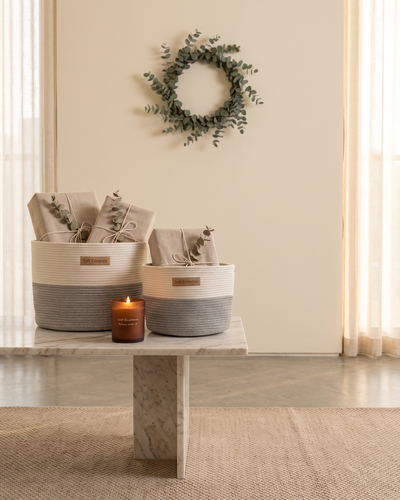
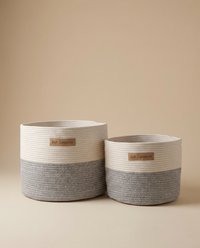
What comes off the surfaces has to go somewhere, and this is where soft storage earns its place. A pair of woven cotton baskets will take throws, chargers, books and children's things out of sight in a moment, and can be carried room to room as the evening moves. Unlike a closed box, an open basket stays honest. You can see what is in it, so it does not quietly become a place where things go to be forgotten.
Light is the first decoration
Ramadan evenings are long, and overhead lighting is unkind to a long evening. It flattens a room and makes people tired without their knowing why.
Turn the main lights down or off and build the room from lower sources instead. Table lamps, floor lamps, and candles at seated eye level. The room will feel larger, softer and considerably more restful, and conversation tends to slow to match it.
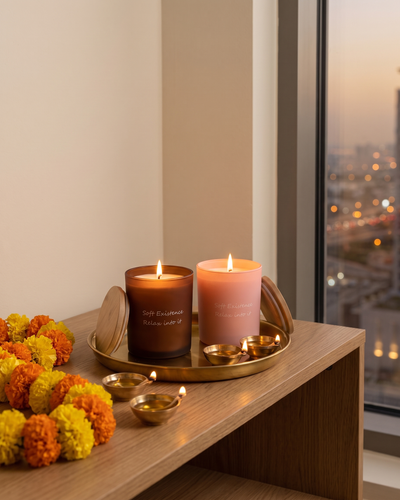
One well-placed candle does more than several scattered ones. Put it where people will be sitting, not where it looks best from the doorway.
Scent, and the one mistake to avoid
Here is the practical part that gets overlooked. During fasting hours, a strong food-adjacent fragrance in the house is genuinely difficult. Vanilla, caramel, coffee and heavy sweet gourmand scents are lovely in December and unkind at four in the afternoon in Ramadan.
Save those for after iftar. Through the day, if you want scent at all, keep it clean and quiet.
After the table is cleared, the room can take more warmth. A spiced or woody candle suits the hours when people settle in and stay. Our Golden Hour candle in Cinnamon & Bergamot sits comfortably alongside cardamom coffee without competing with it. For the quiet end of the night, when guests have gone, Quiet Hours in lavender is the gentler choice.
Arranging a majlis for sitting long
A majlis is not arranged for looking at. It is arranged for sitting in, for several hours, with people who will arrive at different times.
Three things make that easier. Leave a clear path from the door to the seating, so nobody arriving late has to negotiate the room. Keep at least one surface within reach of every seat, because a cup with nowhere to go ends up on the floor. And leave one seat more than you expect to need.
Texture does the decorative work: linen, cotton, wood, stone, woven fibre. A restrained palette of cream, sand and warm brown reads as calm and generous, and it flatters low light better than anything bright.
Keeping a busy month calm
The house is used harder during Ramadan than at any other time of year, and reset time is short between one evening and the next.
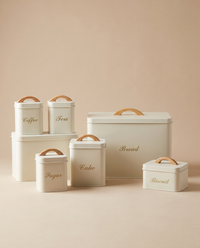
The trick is having somewhere obvious for things to go. Not a system, just a place. One basket in the majlis for throws and cushions. One near the entrance for shoes and bags. One in the kitchen for the serving pieces that come out nightly and would otherwise take a cupboard shelf each time.
Ten minutes of resetting in the morning is worth an hour of tidying at midnight. You can see the full range in Home Organisation.
For the guest who arrives
Ramadan is a season of small, frequent giving, and the pressure is to bring something every time. It rarely needs to be large.
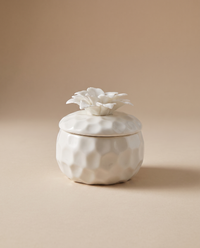
A candle is a good Ramadan gift precisely because it is used rather than displayed. It is finished, and then it is gone, which is a kindness in a month when houses are already full. A sculptural ceramic one goes further, because the vessel is kept long after the wax is finished.
We wrote more about this in The Considered Gift.
After the month
When Eid arrives and the house is at its fullest, most of the work is already done. The surfaces are clear, the storage has a home, the lighting is low and the room is arranged for people rather than for looking at.
That is the whole of it. Ramadan does not ask a home to become something else. It asks it to become calmer, and to hold more people gracefully while it does.