
There is a particular kind of confidence in an open shelf. Unlike a cupboard, it cannot hide its contents or apologise for them later. Everything placed upon it is, in a sense, on record, held in the light, available to the eye each time you pass. This is precisely why the visible shelf is so often got wrong, and so quietly satisfying when it is got right. The instinct, faced with all that exposure, is to fill it. The discipline is to resist.
Restraint, here, is not austerity. It is editing. A shelf styled with care is less a display than a sentence. It has rhythm, pauses, a sense of where one thought ends and the next begins. The empty stretches matter as much as the objects; the eye needs somewhere to rest before it moves on. Designers call this negative space, but at home it reads simply as calm. A shelf that breathes feels intentional. A shelf packed to its edges, however lovely each piece, tends to read as storage that ran out of room.
Texture before colour
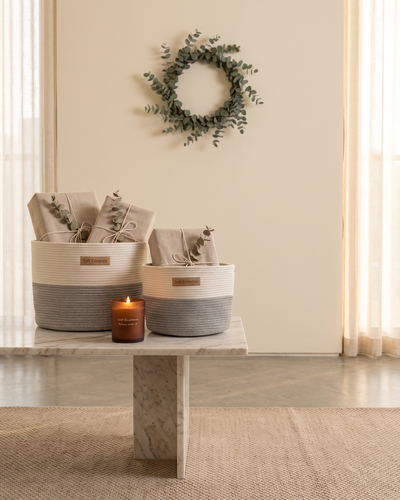
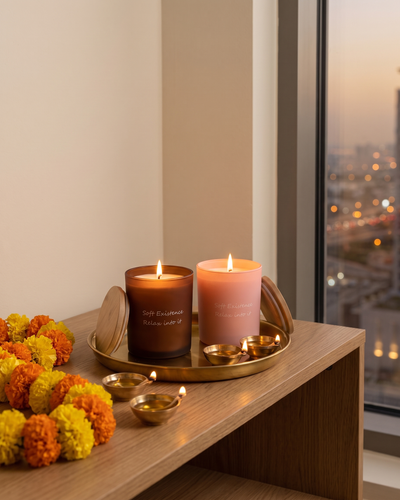
The quiet workhorse of a good shelf is material, not pattern. A woven cotton basket, a candle in frosted glass, wood left close to its grain, these surfaces age in public and improve for it. There is no need for everything to match in colour so long as the materials speak to one another. A considered shelf tends to keep a narrow palette and let texture provide the interest, rather than the reverse. The soft ribbing of cotton rope against smooth ceramic is a more interesting conversation than any two colours could hold.
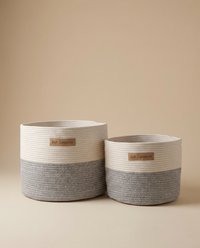
Repetition helps too. A single, generous form, given room around it, will always feel more resolved than a cluster of small things competing for attention. The eye relaxes when it is given one thing to settle on. This is why a calm, sculptural basket can anchor an entire shelf or corner on its own. It is not asking to be noticed. It simply holds.
The most considered shelves are not the fullest. They are the ones that knew when to stop.
Letting the useful look beautiful
Perhaps the most freeing idea is that the objects need not be precious to deserve their place. The things you reach for daily, the storage, the baskets that hold what the room would rather not show, can carry the composition entirely. Our woven cotton baskets were made for exactly this. Soft enough to ease a hard-edged shelf, sturdy enough to hold throws, magazines or the small chaos of a room, and finished with a quiet leather label rather than a loud logo. When a useful object is this well made, putting it on display is not decoration. It is honesty.

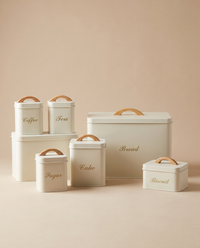
Begin, then, by taking things away. Style with fewer pieces than you think you need, let texture do the work, and leave the gaps where they fall. If you find the practical objects doing the heavy lifting, you are on the right track. That is the point. Our home organisation collection is built for exactly this, useful things made to be seen, so the shelf looks composed long before the rest of the room agrees to follow.