
Candle accidents are rarely dramatic in origin. They come from a jar left on a windowsill next to a curtain, a candle burned down to the last few millimetres, or one lit in a room and then forgotten. The rules that prevent all three are short.
The three distances
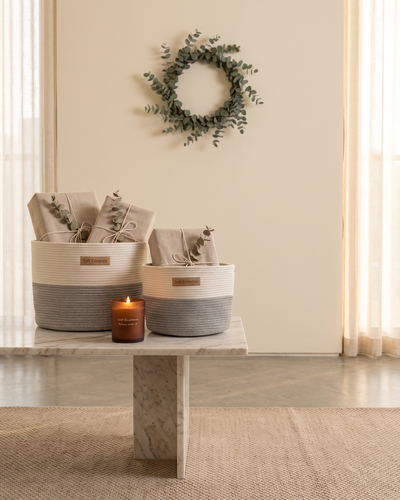
30cm from anything that can burn. Curtains, cushions, paper, dried flowers, books. Dried botanicals are the one people forget - they are extremely flammable and often placed decoratively beside a candle.
10cm between candles. Grouped candles heat each other. Too close and they soften, slump and burn erratically - one flame drawing wax from its neighbour.
Clear above. A shelf directly over a candle takes heat continuously. So does a low ceiling in an alcove. Heat rises further than people expect.
Surfaces
A glass or ceramic vessel gets hot - genuinely hot, not warm. By the end of a long burn the base can mark a surface.
Use something heat-resistant underneath: stone, a tile, a metal tray, a thick wooden board. Not a bare polished table, not a painted surface, and not a plastic tray.
Make sure it is stable and level. Most spilled wax comes from a candle knocked off something narrow, not from the flame itself.
Draughts do more than you think
Moving air is a safety issue, not only a burn-quality one. A flame pushed sideways heats one side of the glass unevenly, which is a common cause of cracking, and it can bring the flame closer to whatever is next to it.
In an air-conditioned home this matters more than in a temperate one. Keep candles out of the path of vents, split units, fans and open windows.
When to stop burning
Stop when about 10mm of wax remains. Below that, the flame sits close to the base, the glass can reach a temperature where it cracks, and the metal wick tab can scorch the surface underneath.
Also stop, and put it out, if:
- The flame is tall, flickering or twice its normal height
- The glass has any crack or chip, however small
- Soot is climbing the inside of the jar
- The wick has drifted to one side and is touching the glass
Time limits
Two to four hours per session. Beyond four, the vessel accumulates heat faster than it sheds it, the wick mushrooms and the flame grows.
Let a candle cool completely before relighting - at least two hours. Relighting a still-warm candle starts it from a higher baseline temperature.
The rule everyone knows and breaks
Never leave a burning candle unattended, and never sleep with one lit. This is the single most common factor in candle fires, and it is entirely a habit problem rather than a knowledge problem.
The practical fix is to attach blowing it out to something you already do - locking the door, brushing your teeth. Deciding to remember does not work; attaching it to an existing action does.
Putting it out properly
Blowing scatters hot wax and sends up a plume of smoke. Better is a snuffer, or a wick dipper - push the wick into the melt pool and lift it straight again. That extinguishes instantly with no smoke, and it primes the wick with wax for the next lighting.
Never use water. It causes the hot wax to spit violently, and on a glass vessel the thermal shock can shatter it.
Do not put the lid on to smother a flame. Wait until the candle is out and cool, then cover it.
Children and pets
Well above reach, and not on anything with a hanging cloth a child can pull. Remember that the vessel stays hot for a long time after the flame is out - a candle extinguished ten minutes ago is still capable of burning a hand.
With cats especially, keep candles off surfaces they jump to and away from anywhere a tail passes at flame height. Trimmed wicks and smaller flames help.
If someone in the house has asthma or is sensitive to fragrance, ventilate and burn for shorter sessions. A clean-burning soy candle with a trimmed wick produces far less particulate than a sooting one, which is a health argument for the trimming habit as much as an aesthetic one.
The short version
- 30cm from anything flammable, 10cm between candles, nothing directly above.
- Heat-resistant, level surface underneath.
- Out of draughts and vents.
- Two to four hours, then let it cool fully.
- Retire at 10mm of remaining wax.
- Snuff or dip - never blow, never water.
- Never unattended, never overnight.
Most of these overlap with the habits that make a candle burn well anyway - a trimmed wick and still air are both a safety measure and the reason a candle lasts. More on that in The Well-Kept Flame.