
There is a particular quality to a house that smells good. Not perfumed - you cannot name the scent from the doorway, and nothing announces itself. It simply reads as clean, warm and looked after.
That effect is almost never produced by spraying something. It comes from removing what smells bad first, then layering small sources of real fragrance so that no single one has to do all the work.
Start by subtracting
Air freshener is a mask, and masking works for about twenty minutes. Every persistent bad smell in a home has a physical source, and finding it is more effective than covering it.
The usual offenders, in rough order of likelihood: the kitchen bin and the seal around its lid; the drain in the kitchen sink; damp cloths and sponges left folded; the washing machine door seal and detergent drawer; shoes by the entrance; the fridge, particularly the salad drawer; and soft furnishings that have absorbed months of cooking.
None of that is glamorous. All of it matters more than anything you can buy. A home with a clean bin seal and a dry sponge is already most of the way there.
Then add air
Stale air smells stale no matter what you put into it. In a climate where windows stay shut for months, this is the hardest part.
Where you can, open two windows on opposite sides of the home for ten minutes in the early morning, before the heat arrives. Cross-ventilation moves far more air than one window does. Where you cannot, run extractor fans properly - during cooking and for fifteen minutes afterwards, not just while the pan is on - and leave interior doors open so air conditioning circulates rather than pooling.
A tightly sealed, permanently recirculated flat develops a particular flat smell that no candle will fix. Air is the fix.
Layer, do not blast
The mistake most people make is one strong source in one room. What reads as expensive is several quiet sources in different places, at different heights, doing slightly different things.
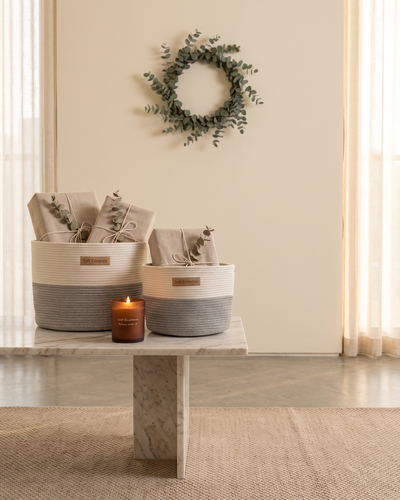
A candle, for the evening. This is the anchor. A soy candle with a properly sized wick will scent an average living room within twenty minutes and keep it there. It is a deliberate, time-bound source - you light it when you want the room to change. Choosing by mood and room is worth some thought, which we covered in A Scent for Every Mood.
Something in the entrance. The hallway sets the impression, and it is usually the least considered room in the house. A small candle, a bowl of dried botanicals, or a lightly scented drawer near the door does disproportionate work.
Something in the linen. Scent on fabric releases slowly every time the fabric moves. A cedar block or a linen sachet in a wardrobe, a light spritz on bed linen before it goes into the cupboard - this is the layer people notice without identifying.
Something from the kitchen, occasionally. Citrus peel and a cinnamon stick simmered in a pan of water for twenty minutes is genuinely effective and costs nothing. It is also the oldest trick in this article for a reason: it adds humidity and scent at once, which is why it reads as homely rather than perfumed.
What to avoid
Plug-in diffusers. They emit constantly, at a fixed intensity, which means your nose adapts within a day and stops registering them entirely. You end up increasing the strength for a smell only visitors can detect. They also tend to be built on synthetic fragrance carried in solvents.
Aerosol sprays. Fast, brief, and they sit on top of whatever they were meant to cover.
Too many competing scents. A vanilla candle in the living room, a lavender diffuser in the hall and a citrus spray in the kitchen do not layer. They collide. Keep a house to two or three related notes.
Heat and humidity change the rules
In a warm, air-conditioned home, fragrance behaves differently than the label suggests. Cold, dry, moving air suppresses scent throw - the same candle that fills a room in a temperate winter can seem muted here. Light it earlier and closer to where people sit, rather than buying something stronger.
Humidity has the opposite effect in unconditioned spaces such as a balcony or entrance: moisture carries scent further, and something delicate can become cloying. We went into this in more detail in Scented Candles in Dubai.
A simple routine
- Weekly: bin seal, sink drain, washing machine seal, sponges replaced.
- Daily: extractor fan during and after cooking; ten minutes of cross-ventilation if the weather allows.
- Evening: one candle, lit an hour before you want the room to feel different.
- Monthly: refresh whatever sits in the wardrobe and the entrance.
That is the whole method. Subtract, ventilate, then layer quietly. Our four soy scents - coffee and vanilla, cinnamon and bergamot, lavender, pomegranate and pink pepper - are built to sit in that last layer rather than dominate it. You can see them in the candle collection.