
Almost every candle sold today mentions soy wax somewhere on the label. Far fewer explain what it means, and a good number use the word while telling you very little about what is actually in the jar.
Here is the plain version.
What soy wax is
Soy wax is made from soybean oil. The oil is extracted from the beans, hydrogenated so that it becomes solid at room temperature, and poured. That is essentially the whole process. It is a vegetable wax, it is renewable, and it is biodegradable.
Paraffin, the traditional alternative, is a by-product of petroleum refining. It has been used for over a century because it is inexpensive, holds a great deal of fragrance and pours easily.
The differences that actually matter
It burns slower
Soy wax has a lower melting point than paraffin, roughly 45 to 55 degrees Celsius compared with 46 to 68. A lower melting point means the wax is consumed more slowly.
In practice, a soy candle typically burns 30 to 50 percent longer than a paraffin candle of the same weight. This is the single most underrated fact about soy. The jar that looks more expensive on the shelf is often cheaper per hour of use.
It carries scent differently
Paraffin gets hotter, so it throws fragrance harder and faster. Soy releases it more gradually.
Whether that is better depends entirely on the room. In a large, cool, draughty space, paraffin's strength is useful. In a warm home where heat is already lifting the fragrance for you, soy's gentleness is the advantage. The scent unfolds instead of arriving all at once, and it rarely becomes overwhelming in a closed room.
It burns more cleanly
Soy produces noticeably less soot. You can see this over time on the inside of the glass and, in stubborn cases, on the wall above where a candle habitually sits.
Two honest caveats. Any wick produces some soot, and most of what people call a sooty candle is really an untrimmed wick rather than the wax. And a candle is not an air purifier. Soy is the cleaner of the two options, not a health product.
It washes out
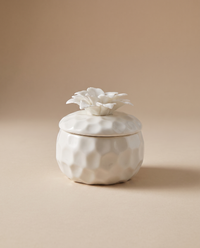
A small practical pleasure. Spilled soy wax lifts with hot soapy water. Paraffin generally does not. It also means the vessel can be cleaned and kept once the candle is finished, which is the whole point of a candle such as Bloom, in a vessel worth keeping.
How to read a candle label honestly
This is where most of the marketing happens.
"100 percent natural soy wax" means what it says. This is what you want.
"Soy blend" or "soy wax blend" means soy mixed with something else, very often paraffin. The proportion is rarely stated, and it can be as little as a quarter soy. Not dishonest, but not the same thing.
"Made with soy wax" is the vaguest of the three. It confirms only that some soy is present.
No wax stated at all usually means paraffin. Brands mention soy when they have it.
Every Soft Existence candle is 100 percent natural soy wax, and we would rather say the number than the adjective.
Getting the most out of it
Soy rewards patience more than paraffin does, and punishes impatience more visibly.
The first burn decides everything. Soy wax has a memory. On the first light, leave it until the melted pool reaches the full edge of the vessel. In a 12oz candle that is usually two to three hours. If you put it out before then, the candle will tunnel down the middle for the rest of its life and you will lose a third of the wax to the sides. This one habit matters more than every other piece of candle advice combined.
Trim the wick to five millimetres each time. A long wick produces a large flame, a large flame produces soot, and soot marks the glass.
Four hours maximum. Beyond that the vessel overheats, the wax gets too hot and the fragrance actually dulls rather than strengthening.
Keep it out of the draught. Under an air conditioning vent a flame flickers constantly, which burns the wick unevenly and carries the scent away as fast as it is released.
One thing that is not a fault
Soy sometimes develops a pale, slightly crystalline surface, or the wax pulls away from the glass in patches. This is called frosting, and it is a natural property of vegetable wax. It has no effect on scent, burn or quality. It is, if anything, a sign that the wax is genuinely soy rather than a blend engineered to look flawless.
The short version
Soy burns slower, cleaner and gentler. It suits warm homes particularly well. It costs a little more per jar and usually less per hour. And it asks one thing of you in return, which is patience on the first burn.
If you would like to go further, read The Well-Kept Flame, or start with Design Candles.