
Kitchen cabinets do not become cluttered through any single decision. They fill by accretion - a duplicate here, a gift there, a lid whose container left years ago - because nothing is ever required to justify staying.
Decluttering them properly is less about discipline than about making the decision once, deliberately, and then changing what the cabinet is for.
Empty the whole cabinet first
Do not tidy in place. Tidying in place rearranges the problem and always leaves you with more than you should have, because an object sitting where it has always sat is invisible.
Take everything out onto the counter or table. One cabinet at a time - the whole kitchen at once is how a Saturday becomes a disaster you abandon halfway through.
Wipe the empty shelf. This matters more than it sounds: a clean empty shelf makes you reluctant to put rubbish back on it.
The four questions
For each item, in order:
Have I used this in a year? Not would I, not could I. Have I. A year covers every seasonal use exactly once.
Do I already have something that does this? Kitchens accumulate near-duplicates - three sieves, two peelers, four almost-identical mugs. Keep the best one.
Is it complete and working? Lidless containers, chipped bowls, the blender with the missing part. These occupy full-price space at zero value.
If it vanished, would I replace it? The most useful question. Most people find the honest answer to a surprising number of things is no.
The categories that hide the most
Food containers. Almost always the worst cabinet in the house. Match every base to a lid; anything unpaired goes. Then keep only as many as you genuinely use in a normal week.
Mugs and glasses. Households keep two to three times what they use. Count how many people actually drink here and keep that number plus a few.
Single-use gadgets. The avocado tool, the egg slicer, the garlic press you own but never reach for.
Spices. Ground spices lose their character after about a year. Most spice shelves contain jars from several years ago that add colour and nothing else.
Bags of bags. Every kitchen has one. Keep a handful, recycle the rest.
Reload by frequency, not by category
This is where most declutters fail - people sort beautifully, then put everything back exactly where it was.
Eye level and the front: daily items only. Everyday plates, glasses, the pans you actually cook with.
Lower shelves: heavy things. Mixing bowls, casserole dishes, appliances. Weight belongs low.
Top shelf: genuinely occasional. Serving platters, the large roasting tin, anything seasonal. If you need a step to reach it, it should be something you fetch a few times a year.
Nearest the point of use: the strongest principle of all. Mugs beside the kettle, not across the room. Pans near the hob. Chopping boards near the prep space. Most kitchen frustration is walking.
Two things that make it hold
Use the vertical air. Most cabinets waste ten to fifteen centimetres above every stack. A shelf riser or a stacking container converts dead air into a whole extra layer, which is usually what lets the counter clear as well.
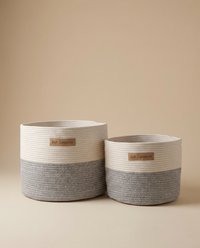
Group loose things into containers. Small items scattered on a deep shelf are unreachable and get forgotten, then re-bought. A shallow basket or bin that pulls out like a drawer turns the back of a deep cabinet from dead space into usable space. This one change does more for a deep cabinet than any amount of sorting.
Stopping the drift back
Three habits, none of them demanding.
One in, one out for anything that stacks - mugs, containers, pans. New one arrives, old one leaves.
Keep a slow shelf. If you cannot decide about something, put it on one designated shelf with a mental date. If you have not reached for it in six months, the decision has made itself.
Reset one cabinet a month. Ten minutes, one cabinet, in rotation. Far easier than a twice-yearly overhaul and it never gets bad enough to dread.
Decanting is the last step, not the first
It is tempting to buy containers before you start. Do not. You will buy for the volume you currently have rather than the volume you should have, and the containers become storage for things you were about to get rid of.
Declutter first. Then decant what remains, which will be less than you expected - and matching containers on a half-empty shelf look composed in a way that mismatched packets never do.
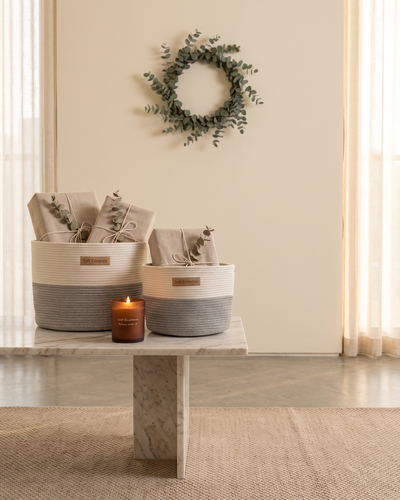
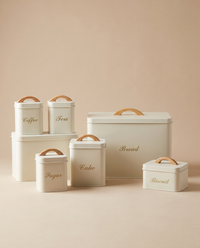
For the surfaces rather than the cupboards, see Kitchen Counter Organisation. The canister sets - the Grand Maison six-piece among them - are in kitchen storage, and the baskets for corralling loose things in home organisation.