
Most kitchen counters are not disorganised. They are simply holding more objects than there is room for, and no amount of rearranging fixes an arithmetic problem.
Clearing a worktop permanently is less about storage products than about a decision: what has earned the right to occupy the most valuable surface in the house.
Start with the frequency test
Take everything off the counter. All of it, onto the table. Then put back only what you use every single day.
For most households that is genuinely short - the kettle, one board, a utensil pot, the coffee setup, maybe a fruit bowl. The food processor used monthly, the blender used at weekends, the toaster used twice a week: none of those pass. They go into a cupboard.
This feels inconvenient for about four days and then stops feeling like anything. The counter you gain is used every time you cook, which is a better trade than saving eight seconds on the appliance you use least.
The one-metre rule
You need one continuous metre of genuinely empty counter, next to the hob or the sink, permanently. Not a metre that is currently clear. A metre that is never used for storage.
This is where you actually prepare food, and its absence is the reason kitchens feel cramped regardless of their size. Defend it. Everything else can be negotiated.
Group what stays
Objects scattered individually across a worktop read as clutter. The same objects gathered into two or three defined groups read as arranged - and the difference is almost entirely visual, not quantitative.
Use a tray. The oldest trick in kitchen styling and still the most effective. Put the oil, salt and pepper on a small tray beside the hob. They stop being three stray items and become one composed object. It also means you can lift all three to wipe underneath, which is why the surface stays clean.
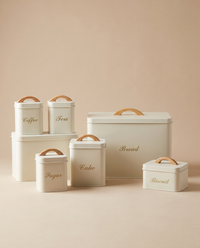
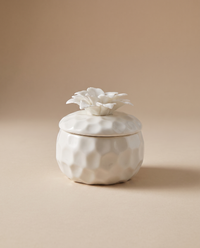
Match your containers. Six mismatched packets look like mess. The same six goods decanted into matching canisters look like a decision. This is the single highest-impact change in most kitchens, and it costs less than replacing anything structural.
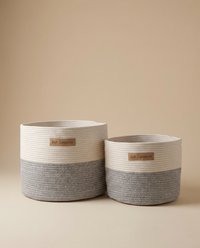
Corral the small things. A shallow basket by the kettle for tea, sweeteners and the things that otherwise migrate.
Small kitchens and no pantry
Most apartments here have a galley kitchen and no pantry at all, which means the counter absorbs everything a pantry would have taken.
Go vertical. The wall between counter and wall units is usually dead space. A narrow rail or a single shelf takes the utensil pot and the spice jars off the surface entirely.
Use the height inside cupboards. Most cupboards waste fifteen centimetres above every stack. A shelf riser or a stacking container converts that into usable space, which is what lets appliances come off the counter.
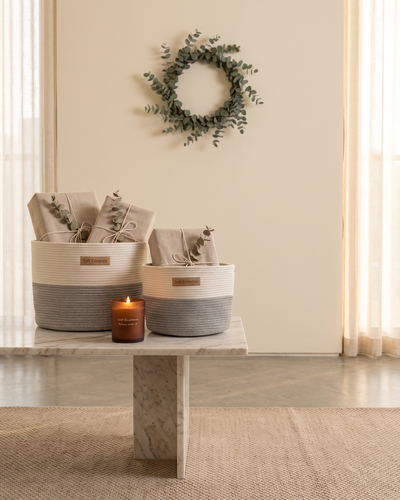
Put one basket somewhere else. The overflow that has no kitchen home - spare bags, batteries, the things that accumulate by the kettle - can live in a basket in the next room. This is not cheating; it is recognising that a small kitchen cannot hold everything a family generates. We wrote about using a single basket this way in The Composed Shelf.
What a minimalist counter actually looks like
Not empty. An entirely bare worktop reads as unused rather than calm, and it is miserable to cook on.
What works is a small number of things with visual weight, in materials that repeat. Wood, glass, stoneware, one metal. Three or four objects, two of them useful and one of them simply good to look at. A board leaning at the back, a canister set, a bowl.
The restraint is in the palette more than the count. Six objects in three materials look calm; three objects in three clashing colours do not.
Keeping it that way
Two habits hold it.
Reset at night. Two minutes after dinner, everything goes back to its place and the surface gets wiped. A counter that starts each morning clear rarely fills up; one that starts half-full is full by evening.
Nothing lands without a home. The counter becomes a dumping ground for post, keys and shopping because it is the first flat surface inside the door of most flats. Give those things a destination elsewhere - a bowl or a basket in the hall - and the kitchen stops absorbing them.
The short version
- Take everything off. Return only daily-use items.
- Keep one metre permanently empty beside the hob or sink.
- Group what remains onto trays and into matching containers.
- Go vertical before you give up counter space.
- Reset the surface every night.
The containers do a lot of the visual work here, which is why decanting is usually the first thing we suggest. Our canister and bread bin sets are in kitchen storage, and the baskets for everything that belongs somewhere else are in home organisation.