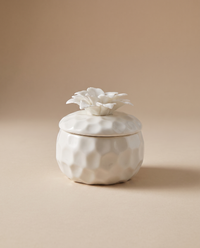

The burn time printed on a candle is a laboratory figure - one wick, still air, controlled temperature, uninterrupted burning. Almost nobody gets it. Here is what a candle should realistically give you, and what quietly takes hours off it.
The rule of thumb
A reasonable estimate for a soy container candle is six to nine hours of burn time per 30g of wax. So:
- 100g: roughly 20-30 hours
- 200g: roughly 40-55 hours
- 300g: roughly 60-80 hours
- 500g, multi-wick: roughly 90-110 hours
In practice, if you light a 200g candle for three hours a couple of evenings a week, it lasts around four to five months. That is the number most people actually want, and it is rarely the one on the box.
Wax changes it more than size does
Soy has a low melting point and burns slowly and evenly - typically 30-50% longer than paraffin at the same weight.
Paraffin burns hotter and faster. It throws scent more aggressively for it, which is the trade.
Beeswax is the longest-burning of the common waxes, and the most expensive.
Coconut and blends sit near soy, sometimes slightly longer.
Two candles of identical weight and price can differ by twenty hours purely on wax. It is the specification worth checking, and the one most often left off the label. More on why in Soy Wax, Explained.
What shortens it
Not trimming the wick. The biggest single factor. An untrimmed wick produces a taller flame that consumes wax faster while throwing no more scent. Trimming to five millimetres before every burn can add 10-25% to a candle's life - a genuinely large return for five seconds of effort.
Draughts. A flame pushed sideways burns unevenly and faster, and in an air-conditioned home this is constant. Moving a candle a metre out of the airflow is worth real hours.
Burning too long in one go. Past about four hours the glass overheats, the wick mushrooms and consumption climbs. Two to four hour sessions are the efficient range.
Tunnelling. The most expensive mistake of all - a tunnelled candle abandons a ring of wax against the glass permanently. That can be a third of what you paid, unrecoverable. See How to Fix Candle Tunnelling.
How long on a warmer
Considerably longer, because nothing is being consumed - no flame, no combustion, so the wax stays in the jar. A candle used only on a warmer can last two to three times its rated burn time.
The catch is that fragrance is finite regardless. The oil evaporates whether a flame is present or not, so you may end up with plenty of wax that has stopped smelling of anything. Wax remaining is not the same as candle remaining. We went into the trade-offs in Do Candle Warmers Make Candles Last Longer?
Do unused candles expire?
They do not spoil in any dangerous sense, but they fade.
Soy: best within one to two years. It does not go off, but the fragrance quietly weakens.
Paraffin: holds fragrance a little longer, up to around five years.
Beeswax: effectively indefinite, and often improves as it develops a pale bloom on the surface, which is harmless.
What actually kills a stored candle is heat and light. A candle left in sun or in a room above 25C loses its top notes within months and can sweat or discolour. Kept in a cool, dark cupboard with the lid on, the same candle holds for years.
That lid matters more than people assume - it is not decorative. It slows evaporation of the fragrance oil between burns, which in this climate is the main reason a candle smells weaker on its tenth lighting than its first.
When to stop burning it
Stop when about ten millimetres of wax remains in the base. Below that the glass gets hot enough to crack and the wick tab can scorch whatever the candle is standing on.
That last centimetre is not waste. Scrape it out and use it in a warmer, or melt it out with hot water and reuse the vessel.
Getting the most out of one
- Full melt pool on the first burn - two to four hours, until the wax reaches the glass.
- Trim to five millimetres every single time.
- Two to four hour sessions, no longer.
- Away from vents, fans and open windows.
- Lid on between burns; cool, dark storage.
- Retire it at ten millimetres and use the remainder on a warmer.
Done consistently, those habits are worth twenty or thirty hours on a 200g candle - a meaningful fraction of a second candle, for no cost at all.
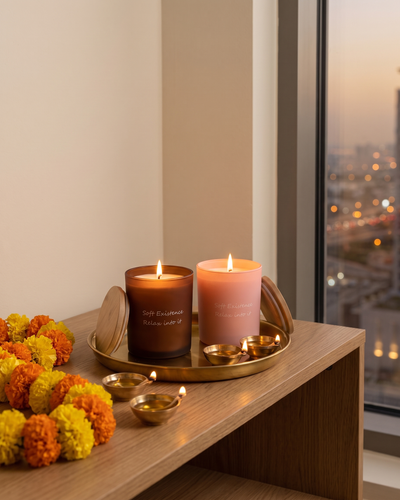
Our soy candles - from Golden Hour to Nocturne - come with a bamboo lid for exactly the storage reason above. You can see the four scents in the candle collection.