
Most flour is sold in paper. Paper is permeable to air, moisture, odour and insects, which makes it a shipping material rather than a storage one. In a temperate kitchen you can get away with leaving it in the bag. In a kitchen that sits at 24C with humidity outside the window, you cannot.
Here is what actually goes wrong, and what to do instead.
What happens to flour in a warm kitchen
It absorbs moisture. Flour is hygroscopic - it pulls water from the air. Damp flour clumps, weighs more than the recipe assumes, and bakes differently. In extreme cases it grows mould.
The oils go rancid. This is the one people miss. Wholemeal and nut flours contain germ oils that oxidise. Warmth accelerates it, and the result is a faintly stale, crayon-like smell. White flour lasts far longer because the germ has been removed.
It absorbs odours. Stored near spices, coffee or onions, flour takes on their smell within weeks.
Weevils. The eggs are usually already in the flour when you buy it, laid in the grain before milling. They are harmless and invisible, and they hatch when conditions are warm enough. This is why an unopened bag can develop insects with no route in.
How to store flour so it does not attract weevils
Since the eggs typically arrive with the flour, the strategy is to stop them hatching rather than to keep insects out.
Freeze new flour for 48 hours before decanting. This kills eggs and larvae, and it is the single most effective step. Let the bag return to room temperature fully before opening it, or condensation will form inside.
Decant into an airtight container. Even if eggs survive, a sealed container confines any problem to one vessel rather than letting it spread across a cupboard.
Do not top up. Adding new flour on top of old is how a small problem becomes a permanent one. Empty and wipe the container before refilling.
A bay leaf in the container is the traditional deterrent. The evidence is mixed but it costs nothing and does not affect flavour.
If you do find weevils, discard the affected container's contents, wash the vessel in hot soapy water, dry it completely, and check everything nearby - they move between packets.
How long dry goods actually keep
- White flour: around a year sealed and cool. Six to eight months in a warm kitchen.
- Wholemeal flour: three months at room temperature. Considerably longer refrigerated or frozen.
- White rice: effectively indefinite if kept dry and sealed.
- Brown rice: six months. It has the same germ-oil problem as wholemeal flour.
- Granulated sugar: indefinite. It does not spoil; it only clumps.
- Brown sugar: indefinite, but it hardens as it dries out.
- Ground coffee: two weeks for good flavour, whatever the packet says.
What to store in what
Flour and sugar want a wide opening you can get a measuring cup into, and a genuine airtight seal. A narrow neck means you end up decanting into a bowl every time, which is why the good intention fails within a month.
Rice and pasta want height and volume more than a perfect seal. These are the goods that justify the largest containers.
Coffee wants opacity and a small volume, so you finish it before it fades. Light degrades coffee quickly.
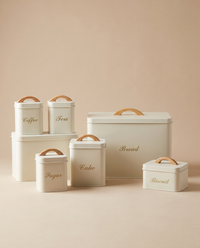
Bread is the exception to everything above. It does not want an airtight seal, which traps moisture and grows mould in this climate faster than anywhere. It wants a container that breathes a little - which is precisely what a bread bin is for, and why it is not simply a large canister.
Do not refrigerate bread. It goes stale several times faster at fridge temperature than at room temperature. Freeze it instead, sliced.
A note on glass, plastic and steel
Glass is inert, does not stain or hold odour, and lets you see the level - which matters more than it sounds, because you restock what you can see. It is heavy and it breaks.
Plastic is light and cheap but scratches, and scratched plastic holds oils and smells. Turmeric will stain it permanently.
Steel is durable and light-proof, which suits coffee and anything that degrades in light, but you cannot see what is inside or how much is left.
Most kitchens end up mixing all three. The thing that matters more than the material is the seal, and whether the lid is easy enough to open one-handed that you will actually keep using it.
Where to put them
Away from the oven and the hob, which is the mistake nearly every kitchen makes - the cupboard beside the oven runs several degrees warmer than the rest of the room and halves the life of what is in it. Away from the window, for the same reason plus light. And ideally not above the kettle, where steam rises into the cupboard every morning.
A cool internal cupboard, or a shelf away from appliances, is worth reorganising for.
The short version
Freeze new flour for two days, decant everything into airtight containers with wide openings, never top up old stock with new, and keep it all away from the oven and the window. That covers most of what goes wrong.
Our own canister and bread bin sets are built around that distinction - sealed vessels for dry goods, a ventilated bin for bread. You can see them in kitchen storage, alongside the Atelier Grey set.